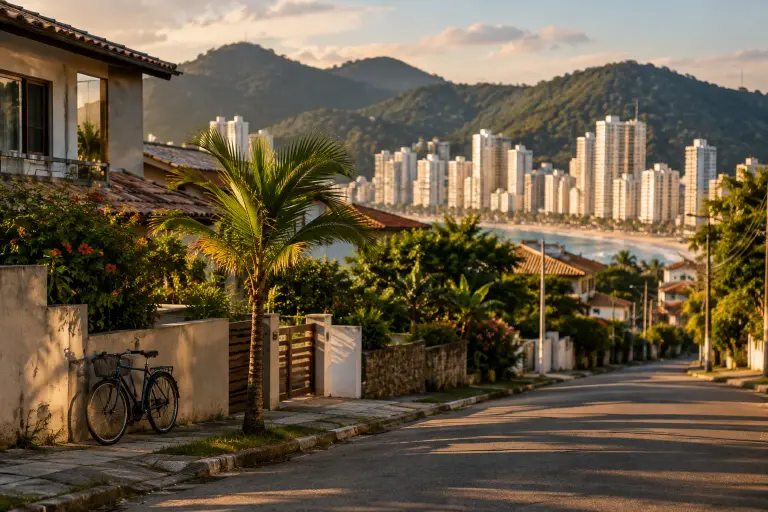
Most people who consider moving to Porto Belo arrive through the postcard: the calm bay, the island across the water, the fishing boats on the sand. The question that matters comes later, on a Tuesday in July, when the season is over: which neighborhood makes daily life work.
How Porto Belo is laid out
Urban life in Porto Belo fits into four parts: the Perequê beachfront, facing the cove and full of new developments; Centro, facing the island; the residential neighborhoods inland, such as Vila Nova and Jardim Dourado; and Alto Perequê, near the BR-101 highway, where VivaPark is growing.
The town still keeps a small-town pace, with artisanal fishing next to new buildings.
The numbers from IBGE, Brazil's national statistics office, show the speed. In the 2010 Census, Porto Belo had 16,083 residents. In the 2022 Census, it had 27,688, a 72% increase in 12 years. The IBGE estimate for 2026 reaches 32,615.
The land area explains the small-town feel. The municipality covers 93.7 km², with 295.58 people per square kilometer in the 2022 Census, less than a quarter of Itapema's density and the lowest of the beach towns from Bombinhas to Balneário Camboriú, the high-rise beach city about 30 km north.
Growth comes with construction. According to DWV data published by Portas in January 2026, Porto Belo had the highest number of new units launched in 2025 among the four cities in the survey, ahead of Itapema, Itajaí and Balneário Camboriú.
If you move here, expect building sites, trucks and changing streets for a few years, and the neighborhood you choose decides how much of that enters your routine.
The neighborhoods and their character
The town is compact, but its neighborhoods (bairros) are quite different. Your choice changes the distance to the beach, the construction noise and the time you spend in the car.
Perequê
This is the urban beachfront, facing the cove between Centro and the Itapema border. It has most of the new buildings and off-plan developments, the busiest street shopping and the most popular beach in summer.
The beaches of Porto Belo generally have calm water, and Perequê is the most urban of them.
If you want to walk to the beach and to the bakery, it makes sense. The price is the bustle: in high season the beachfront avenue fills up, and this is the neighborhood that lives with the most construction. The off-plan apartments in Perequê show what is being built there.
Centro
The historic center faces Porto Belo Island and holds City Hall and most public services. It has older houses, narrow streets and a small-town rhythm, with fishing still visible on the beach.
Vila Nova and Jardim Dourado
These are residential neighborhoods away from the beach avenue. On OpenStreetMap, Vila Nova lies between Centro and Perequê, further inland, and Jardim Dourado lies west of Perequê, toward the BR-101 highway. The town's 24-hour urgent care unit (UPA) is in Jardim Dourado, according to the CNES registry checked in October 2026.
VivaPark
Located in Alto Perequê, near the BR-101. It is an open planned neighborhood, with public streets, green areas, and lots and buildings delivered in phases. It appeals to people who want new streets, wide sidewalks and room for children, and who accept living farther from the sea in a place that is still taking shape.
Real distances to neighboring towns
Porto Belo lives off its relationship with the towns around it. Many residents live here and work, study or see doctors in Itapema and Balneário Camboriú, and the BR-101, the federal highway that runs along the coast, is the way to almost everything.
The distances below are by road, starting at Porto Belo City Hall, calculated with the OSRM router on OpenStreetMap on October 4, 2026:
| Destination | Driving distance |
|---|---|
| Downtown Bombinhas | 6.3 km |
| Meia Praia, in Itapema | 9.1 km |
| Downtown Itapema | 15.3 km |
| Downtown Balneário Camboriú | 31.2 km |
| Navegantes Airport | 49.6 km |
| Florianópolis Airport | 82.0 km |
Travel time changes a lot with the season. Outside summer, the drive to Itapema is quick. In January, on holidays and on summer weekends, traffic on the BR-101 and on the beach access roads slows down, and the trip to Balneário Camboriú can take a whole morning.
If you will fly often, weigh the distance to Navegantes. A same-day round trip is doable, but leave margin, especially in summer.
How to get there
Porto Belo sits right off the BR-101, between Tijucas and Itapema. Coming from the north (Navegantes Airport, Itajaí or Balneário Camboriú), you drive south and pass Itapema before you arrive. Coming from Florianópolis, you drive north through Tijucas.
From the highway, the exits lead to Perequê, Centro and, toward the peninsula, Bombinhas. Navegantes is the shortest drive from an airport; Florianópolis often has more flights, at almost twice the distance.
Services, healthcare and what is still growing
Porto Belo has neighborhood shops, supermarkets, pharmacies, clinics and schools, but its infrastructure is still that of a small town that grew fast. A family will look for some things elsewhere.
Healthcare is the most important one. In the CNES open data checked on October 4, 2026, the town had no facility registered as a hospital. Emergencies go to the 24-hour UPA, and hospital stays depend on neighboring towns such as Itapema.
There is a plan to change this, with no date for full operation yet. In October 2025, a private hospital complex was announced in town, with 30 beds planned and full capacity projected for 2029. For now it is a company announcement, not a finished building: count on it only once it opens.
Other weak points show up day to day:
- construction on several blocks at once, with noise and dust;
- fewer medical specialists, courses and nightlife options than in Balneário Camboriú;
- frequent trips to Itapema and Balneário Camboriú for services, which cost time and money;
- heavy traffic in the summer months.
Summer and the off-season
The gap between seasons is what surprises newcomers most. It even shows in the Census: of the 15,093 dwellings counted in Porto Belo in 2022, 3,698 were for occasional use, or 24.5%, according to IBGE table 4711. These are houses and apartments used only on vacations and holidays.
In Itapema the share was even higher: 39.3% of dwellings for occasional use, in the same IBGE table.
Proportionally, then, Porto Belo has more year-round residents and fewer shuttered homes off-season than its neighbor. In practice, the town empties out less in winter.
Remember this is the Southern Hemisphere: summer means December to February, and the visiting crowds fill beaches, restaurants and roads. Outside it, the town slows down. If you like calm, March to November is the best argument for living here. If you need activity all year round, those months may feel long.
Itapema or Porto Belo
The comparison comes up in every conversation about the region. Itapema is bigger, more vertical and better served, with a hospital and a beachfront of tall towers. Porto Belo is lower, calmer and still building its infrastructure.
The IBGE numbers sum up the difference:
| Indicator | Porto Belo | Itapema |
|---|---|---|
| Residents, 2010 Census | 16,083 | 45,797 |
| Residents, 2022 Census | 27,688 | 75,940 |
| Estimated population, 2026 | 32,615 | 88,842 |
| Area (km²) | 93.7 | 58.2 |
| People per km², 2022 | 295.58 | 1,304.59 |
| Dwellings for occasional use, 2022 | 24.5% | 39.3% |
Sources: IBGE, 2010 Census, 2022 Census, population estimates and dwellings by type.
Both towns grew at a similar pace between the two IBGE censuses: 72% in Porto Belo and 66% in Itapema. The difference is density, which shapes street noise, the shade of the towers and the competition for a spot on the sand.
Many families settle the question by living in one and using the other. From Perequê to Meia Praia is only a few kilometers, and the services of both towns add up in daily life.
How to test the town before deciding
A vacation shows you summer Porto Belo. To get to know the rest of the year, test four things off-season:
- the drive to work or school, at the real time, on a weekday;
- the nearest supermarket and pharmacy to the neighborhood you like, on foot or by car;
- the route to the UPA and to the hospital in Itapema;
- a Saturday in January, repeating your most important route.
If you are buying from abroad
A few Brazilian basics apply to every buyer, foreign or not. You need a CPF, the Brazilian taxpayer number; foreigners living abroad can request it free of charge and complete the process at a Brazilian consulate, according to the official gov.br page checked on October 4, 2026.
Real estate brokers in Brazil must be registered with a regional council called CRECI (Law 6,530/1978), and property transfers pay ITBI, a municipal transfer tax set by each city under article 156 of the Constitution. Prices on this site are always in Brazilian reais.
Which Porto Belo neighborhood fits your routine
Moving to the coast seems simple until the first week of July, when daily life shows up without the summer filter. Porto Belo works well for many people, as long as the choice is made with the numbers and the weak points on the table.
Three principles help you decide:
- Choose the neighborhood for your routine, not for the beach photo: work, school and healthcare define your days.
- Count on Itapema and Balneário Camboriú for part of your services, and time that drive in high season.
- Treat growth as something that brings new services and also construction, traffic and a changing landscape.
The practical next step is to spend two or three days in town outside summer, driving at the hours you would go to work or take the kids to school.
Before that, it helps to understand the costs of the move in our article on the cost of living on the Santa Catarina coast and to see what is being built among the off-plan apartments in Porto Belo.
If you are thinking of buying, you can talk to our specialist in an online investment consultation from wherever you are, or book a visit to the show unit and the site the next time you are in the region.
Porto Belo suits people looking for calm with services nearby, not people expecting a big city by the sea.
Run the numbersOff-plan or fixed income? Compare the same money in Porto BeloCDI: 13.65% a year (Central Bank of Brazil, 01/10/2026)Open the calculator