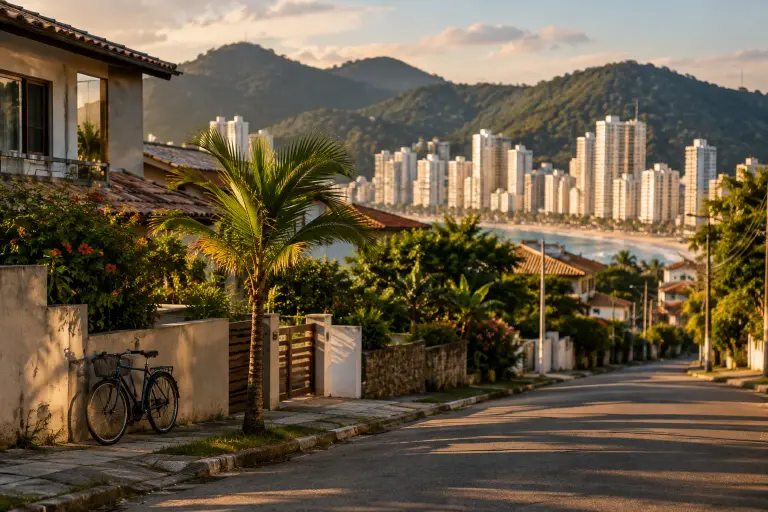
In September 2026, the listed price per square meter of a home in Itapema was R$ 15,340. In Joinville, in the north of the same state, it was R$ 8,446.
This article separates what has public data from what does not, item by item, for anyone thinking of living on the northern Santa Catarina coast or spending part of the year there.
How much it costs to live in Santa Catarina
Santa Catarina, in southern Brazil, is among the most expensive Brazilian states to live in, and housing weighs the most.
Within the state, the gap between cities is wide: the northern coast has the most expensive property, while Joinville and Blumenau have much lower prices per square meter. With no official index by municipality, the comparison has to be made item by item.
The most recent state-level reference is Serasa's "Brazilian cost of living" survey, carried out in January 2026 with more than 6,000 people.
According to NSC's coverage in March 2026, average declared monthly spending in Santa Catarina was R$ 4,180. That is the fourth highest in Brazil and 18.75% above the national average of R$ 3,520. For a rough reference, R$ 4,180 is about US$ 800 at the Central Bank PTAX selling rate of October 2, 2026 (R$ 5.2238 per dollar).
In the same survey, average spending on housing in the state was R$ 1,380 a month, on groceries R$ 1,140 and on education R$ 750.
According to the coverage, Santa Catarina leads Brazil in housing spending and ranks in the top three for eating out, transport, leisure and education.
The feeling of pressure is also stronger in the South: 75% of respondents in the region said they felt the cost of living rise over the previous 12 months, against 70% nationwide. The survey is state-level and has no city breakdown, so the northern coast needs to be examined item by item.
What the state average hides
The Serasa average is spending declared by respondents, not product prices. It mixes people who own their home outright with people paying rent or a mortgage, and it mixes inland towns with the capital and the coast.
So it works as a starting point, not as an answer for a specific town. Two families with the same income can have very different living costs in Itapema if one owns its home and the other rents a beachfront apartment.
Housing, the item that sets the coast apart
The FipeZAP Index for September 2026 measures the average asking price in listings of apartments and houses for sale. Among the Santa Catarina cities in the index, the result was:
| City | Average sale price per m² | 12-month change |
|---|---|---|
| Balneário Camboriú | R$ 15,369 | +3.38% |
| Itapema | R$ 15,340 | +4.37% |
| Florianópolis | R$ 13,607 | +8.31% |
| Itajaí | R$ 13,453 | +5.25% |
| São José | R$ 9,110 | +5.45% |
| Joinville | R$ 8,446 | +6.45% |
| Blumenau | R$ 8,202 | +9.06% |
Source: FipeZAP Residential Sale Index, September 2026. Average of the index's 56 cities: R$ 10,015.
A note on reading it: FipeZAP is calculated from asking prices in online listings, not from final sale values. It is good for comparing cities and following the trend, but the price agreed in a negotiation can differ.
Simulation with the FipeZAP average prices of September 2026, only to show the order of magnitude. A 70-square-meter apartment at the average listing price would cost R$ 1.08 million in Balneário Camboriú (70 times R$ 15,369) and R$ 1.07 million in Itapema. At the October 2, 2026 exchange rate, R$ 1.08 million is roughly US$ 206,000.
In Joinville, the same apartment would cost R$ 591,000, and in Blumenau R$ 574,000. The gap between the coast and those two cities exceeds R$ 480,000.</simulacao>
Porto Belo, Bombinhas and Camboriú are not part of the index. For those towns, the way forward is to compare price tables of equivalent units, not to estimate a number.
And rent
FipeZAP also has a rental index, but in Santa Catarina the August 2026 report tracks only Florianópolis, Joinville and São José. There is no public residential rent index for Porto Belo, Itapema or Balneário Camboriú.
In practice, if you plan to rent, look at listings in your chosen neighborhood at more than one time of year. On the coast, the summer season (December to February) changes the supply of furnished homes and short-stay prices.
Condo fees and IPTU
The monthly condo fee (condomínio) depends on the building: size, amenities, front desk and number of units. IPTU, the annual municipal property tax, follows each city's law and property valuation map. There is no reliable public average for either in the region.
For an off-plan apartment, ask the developer for the estimated condo fee of the project and how IPTU will be assessed after handover.
Buildings with many amenities, a heated pool and a 24-hour front desk usually have higher condo fees, and that amount is paid every month, for many years.
When comparing two developments, it can weigh as much as the price difference of the unit. The costs of the purchase itself, such as ITBI (the municipal property transfer tax) and registration at the property registry, are in our guide to the costs of buying property in Brazil.
Electricity, water and transport
Household bills follow the rules of each service, and some changed in 2026.
Electricity
Celesc, the state power distributor, had a tariff review approved by ANEEL, the federal electricity regulator, on August 18, 2026. Since August 22, the tariff for residential customers in group B1 rose 9.29%. The average effect across all customers was 10.82%.
On the coast, consumption changes with the season. Air conditioning in summer and water heating in winter weigh on the bill, and new buildings with gas or solar heating change that balance.
Water and sewage
Each town has its own utility and its own table. In Itapema, Águas de Itapema states that the residential tariff combines a fixed availability charge of R$ 34.42 a month plus a per-cubic-meter rate for each consumption band.
In Porto Belo and Balneário Camboriú, check the current table with the local utility.
A fixed availability charge like Itapema's is billed even in months of low use. If you plan to use the home only part of the year, that minimum water cost, and its equivalent on the power bill, belongs in the twelve-month budget.
Transport
Porto Belo, Itapema and Balneário Camboriú are neighbors linked by the BR-101 highway. There is no comparable public data on transport spending by town, so the best measure is your own routine.
Before choosing a neighborhood, drive to work, school and the supermarket on a weekday at rush hour. If you can, repeat it in January, when the region receives its summer visitors.
Also check which bus lines run near the home and how often, with the company that operates local transport.
Wages and growth
The other side of the cost of living is income. According to IBGE Cidades, with data from the 2024 Central Register of Companies, the average monthly wage of formal workers was 2.5 times the national minimum wage in Balneário Camboriú and Itapema.
In Porto Belo and Bombinhas it was 2.3 minimum wages. The Santa Catarina average was 2.7.
These numbers explain the pressure: people living on local wages on the northern coast earn, on average, a little less than the state average and pay more for housing. People who bring income from elsewhere, such as retirees, remote professionals or investors, feel that gap less.
The region is also growing fast. Porto Belo went from 27,688 residents in the 2022 Census to 32,615 in the IBGE estimate for 2026, up 17.8%. Itapema went from 75,940 to 88,842, up 17%. Bombinhas rose from 25,058 to 29,722, up 18.6%, and Balneário Camboriú from 139,155 to 154,525, up 11%.
If you earn in another currency
If your income is in dollars, euros or pounds, the math changes sides. Costs are in reais, and the weight of each item depends on the exchange rate on the day your income is converted.
Nobody can predict that rate, so your budget should leave room for currency swings in both directions. The conversions in this article use a single date only as a reference point.
Fast-growing towns tend to see more demand for housing, services and school places. What daily life is like in each town is covered in our articles on Porto Belo neighborhoods and the pros and cons of Balneário Camboriú.
How to build your budget on the northern coast
The opening question was whether the northern coast fits your budget. Public data shows that housing is what sets the coast apart from the rest of the state, and that the rest of the bill follows tariffs and state averages.
- Housing is the item that varies most between towns, and it is where the math is decided.
- Where there is no public index, such as rent and condo fees in the region, compare equivalent homes instead of using averages.
- Electricity and water follow official tariffs that change every year; check the current one before closing the numbers.
The practical step is to build a spreadsheet with three columns, one for each town you are considering, and fill in housing with real listing or price table values, expected condo fees, electricity, water and the commute to work or school.
If you plan to buy off-plan to live in or as a second home, a conversation with our specialist helps compare expected condo fees, timelines and prices across towns: book an online consultation or, if you are vacationing in the region, schedule a visit to the show unit and the site.
On the northern coast, the cost of living is decided when you choose the home.
Run the numbersITBI and registry fee calculatorITBI from 1.5% to 3% in cities with a published rateOpen the calculator