
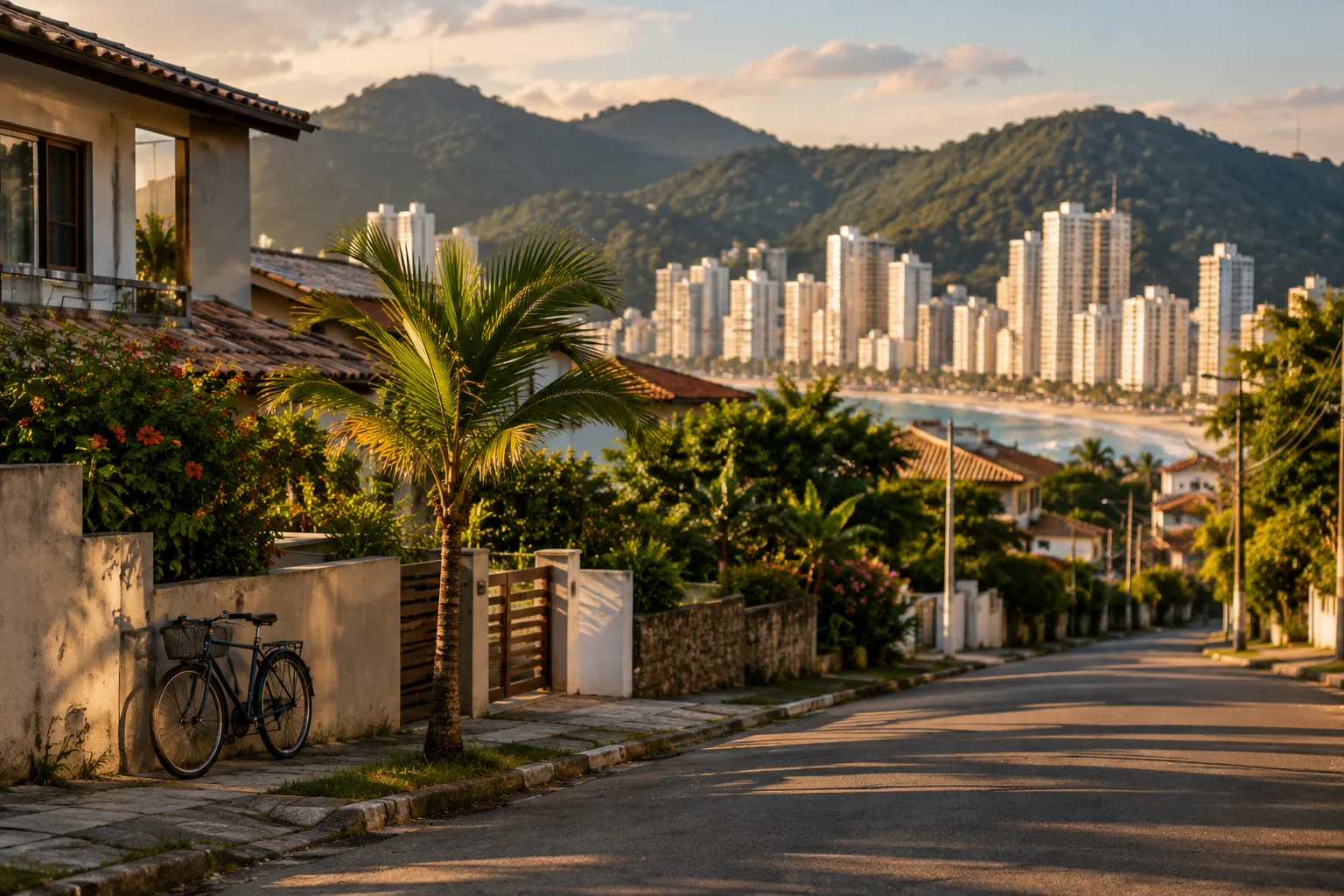
In twelve years, Itapema gained more than 30,000 residents. If you arrive now, you will find a town still under construction, with new towers on the beachfront and whole neighborhoods taking shape on the other side of the BR-101 highway.
Itapema in numbers
Itapema covers 58.2 km² between Porto Belo and Balneário Camboriú. The 2022 IBGE Census counted 75,940 residents and a density of 1,304.59 people per square kilometer. For comparison, Porto Belo had 295.58 and Balneário Camboriú 3,077.70 people per square kilometer.
Growth was fast. The 2010 Census had counted 45,797 people, which means a 66% increase in twelve years. The IBGE estimate for 2026 is 88,842.
One number explains daily life better than any photo. In the 2022 Census, 39.27% of Itapema's dwellings were for occasional use, meaning vacation homes and apartments with no permanent resident, according to IBGE table 4711. In Porto Belo, the share was 24.50%.
In absolute terms, the Census counted 27,423 dwellings occupied by residents and 20,353 for occasional use in Itapema. Another 3,752, or 7.24% of the total, were vacant. Adding the last two groups, 46.5% of the town's units had no permanent resident on Census day.
Living in Itapema means living in a town whose pace changes between summer and winter, and the neighborhood you pick shapes how much you feel it.
Price per square meter
The FipeZAP Index for September 2026 showed R$ 15,340 per square meter in Itapema, up 4.37% in 12 months. Balneário Camboriú stood at R$ 15,369. Both rank among the highest average prices of the 56 cities in the index, which tracks asking prices of residential listings across each city online.
For a rough reference, R$ 15,340 is about US$ 2,940 per square meter at the Central Bank PTAX selling rate of October 2, 2026 (R$ 5.2238 per dollar). The exchange rate moves every day, and property in Brazil is priced and paid in reais.
If you are comparing towns, the data shows that Itapema and Balneário Camboriú have almost the same average price per square meter today: the gap in September 2026 was R$ 29.
Itapema neighborhoods, from the beachfront to the inland side
Itapema's geography reads in strips. Close to the sea are the high-rise neighborhoods. On the hill side, past the BR-101, are lower neighborhoods with houses, local shops and still some empty lots.
Meia Praia
This is the best-known neighborhood and the one with the most construction. It is at the southern end of the beachfront, near the Porto Belo border: from Perequê, the main launch area of the neighboring town, to Meia Praia is 5 km by car, on the same OpenStreetMap route.
In this portal's catalog, on October 4, 2026, 36 of the 90 Itapema developments in launch or under construction were in Meia Praia. The beachfront has a promenade, restaurants and residential towers of many floors. The neighborhood has its own article, on Meia Praia in Itapema.
Centro
Centro concentrates shops, services and banks. The central beachfront is high-rise too. In the catalog, 18 developments in launch or under construction were in Centro. People who want to run errands on foot tend to prefer this area.
Morretes and the neighborhoods by the highway
Morretes lies behind Meia Praia, farther from the sand, and had 16 developments in launch or under construction in the catalog. Further inland are Tabuleiro dos Oliveiras, Várzea, Casa Branca, Sertão do Trombudo, Alto São Bento and Jardim Praia Mar, residential neighborhoods with fewer tall buildings.
In these areas, the trade-off is distance from the beach and crossing the BR-101 every day, in exchange for calmer streets and more space. To see what is under construction in each neighborhood, the page of off-plan apartments in Itapema lists the developments with filters.
Daily life for year-round residents
Healthcare
Itapema has its own emergency care.
According to the CNES open data, Brazil's national registry of health facilities, checked on October 4, 2026, Hospital Santo Antônio de Itapema operates 24 hours, with surgical and obstetric units and care through SUS, Brazil's public health system.
The 24-hour urgent care unit (UPA) is in the same neighborhood, Casa Branca, west of Centro. There are also family health clinics across the neighborhoods, from Meia Praia to Sertão do Trombudo.
From downtown to the hospital is 2.5 km; from Meia Praia, 7.9 km, according to OpenStreetMap routes. In a town with heavy summer traffic, drive that route once before choosing an apartment, ideally on a Saturday in January.
For more complex cases, there are other hospitals in Balneário Camboriú, Itajaí and Tijucas, all less than an hour's drive away.
Distances
Routes calculated on OpenStreetMap on October 4, 2026, without traffic:
| From downtown Itapema to | Driving distance |
|---|---|
| Downtown Balneário Camboriú | 14.4 km |
| Downtown Porto Belo | 12.7 km |
| Navegantes Airport | 33.9 km |
| Florianópolis Airport | 82.4 km |
The BR-101 is the backbone of the region. It links Itapema to its neighbors in a few minutes off-peak, and gets congested in high season, on holidays and on summer weekends.
Summer and winter
This is the Southern Hemisphere, so high season runs from December to February. In those months the town fills up. Beachfront restaurants stay open late, traffic gets heavy and the beach is crowded.
In winter, part of the towers keep their windows shut, as the Census share of occasional-use dwellings shows. For remote workers who like calm, winter can be the best time of year. If you want activity all year round, spend a week in July before you decide.
Seasonality also affects anyone buying for vacation rentals: demand concentrates in a few months, and the rest of the year calls for patience or a different rental plan.
What to weigh before you move
The downsides belong in the math too.
- Price. The average price per square meter is among the highest in Brazil in the FipeZap index. Living near the sea is expensive, and rents follow.
- High-rises. Tall towers on the beachfront mean shade on the sand for part of the day, years of construction next door and more cars on the streets.
- Seasonality. January Itapema and July Itapema are different towns. Shops, traffic and noise change with the season.
- The BR-101. The highway cuts through town and separates the beachfront from the inland neighborhoods. Crossing it is part of life on the hill side.
- Fast growth. A population that grew 66% in twelve years puts pressure on traffic, school places and sanitation. Ask City Hall about planned works for your neighborhood.
- Large supply. With dozens of towers under construction, anyone buying to resell or rent competes with many new neighbors.
If you are buying off-plan as an investment, these points become risks: construction delays, design changes, a developer in financial trouble, the balance adjusted by the INCC (Brazil's construction cost index, which corrects unpaid installments during the build), credit denied at handover and slower resale when supply is high. Past appreciation does not guarantee future appreciation.
Neighboring Porto Belo has a different rhythm, with fewer people and a lot of construction in Perequê. The comparison is in our article on Porto Belo neighborhoods.
Itapema suits people who want a ready-made town by the sea
The question about living in Itapema is rarely the beach. It is daily life: price, the season, the BR-101 and the right neighborhood for your routine.
Before choosing, keep three criteria in mind:
- Pick the neighborhood for your routine, not the view. Beachfront if you want everything on foot; inland if you want space.
- Get to know the town outside high season before buying.
- If you are buying off-plan, look at the building and also the block: what else will be built around it.
To start, shortlist two or three developments in different neighborhoods and compare distance to the beach, expected delivery date and price per square meter.
In the online consultation, our specialist runs that comparison with current price tables; if you are in the region, a visit to the show unit and the site shows you the street as it really is.
Itapema is a good place to live when the neighborhood you choose still works in the emptiest month of the year.
Run the numbersOff-plan or fixed income? Compare the same money in ItapemaCDI: 13.65% a year (Central Bank of Brazil, 01/10/2026)Open the calculator

