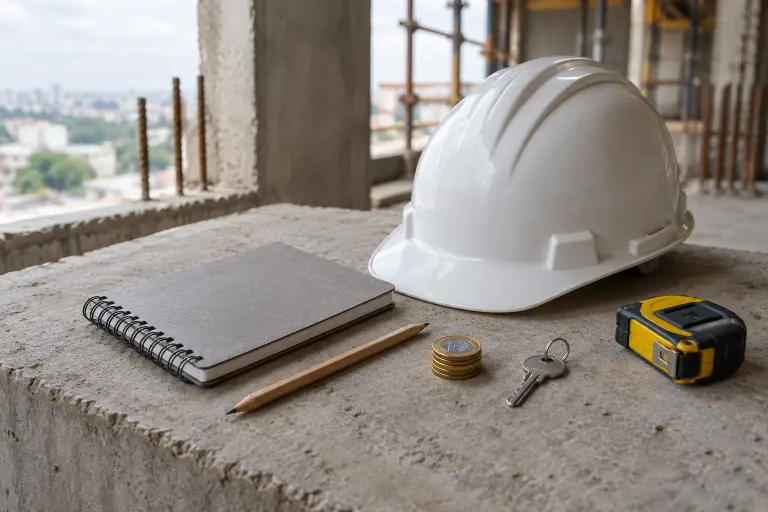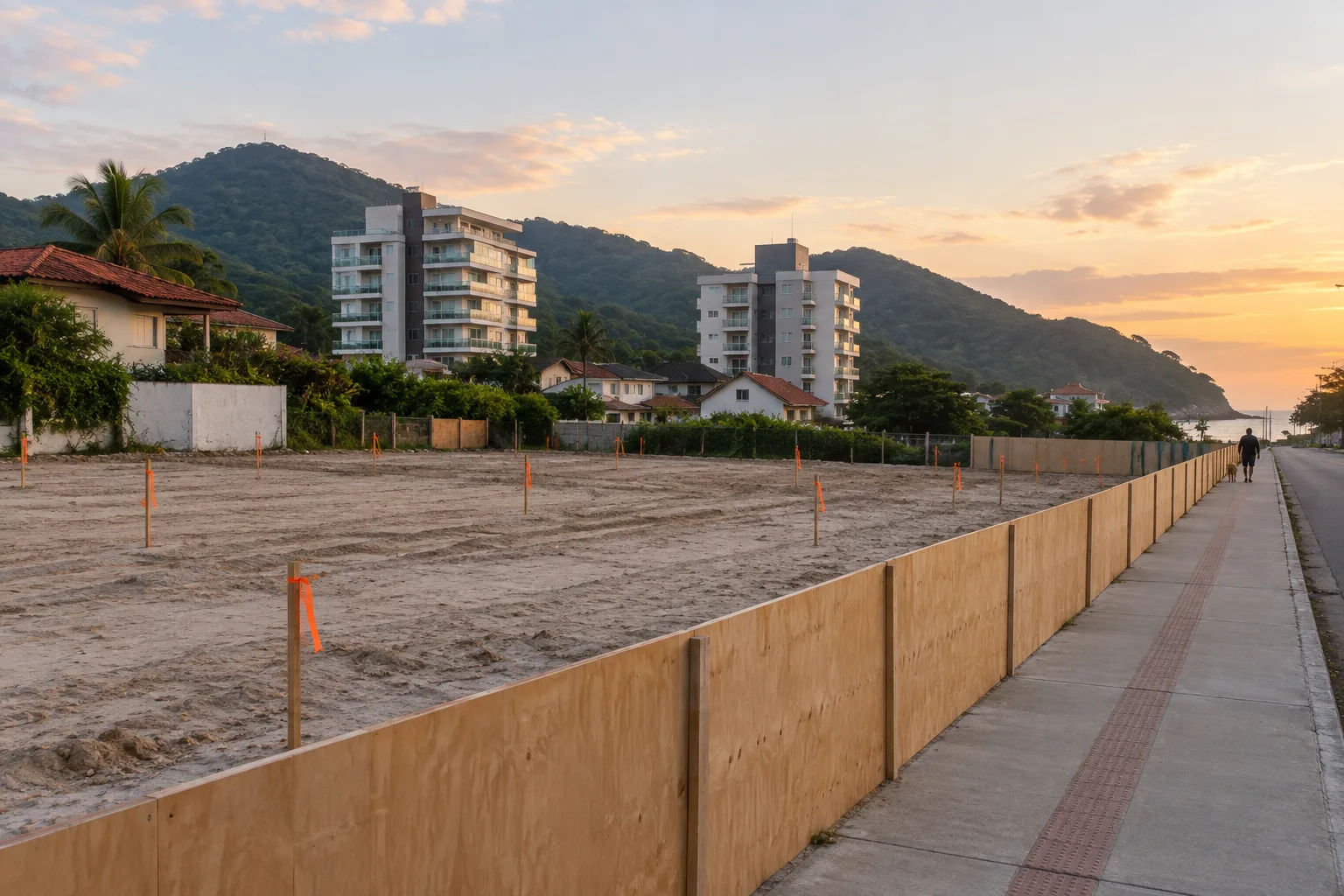
The invitation arrives by message: pre-launch price table, special terms for the first buyers, few units left. The question that decides whether it is a good entry point or a problem rarely appears in the promotional material: has the development been registered yet?
What a pre-launch is
A pre-launch (pré-lançamento) is the period in which a Brazilian developer starts presenting a project to the market before the commercial launch. It serves to gauge demand, adjust the product and build a list of interested buyers.
For the buyer, the appeal is getting in first, with more units to choose from and a price table that is usually the lowest in the project's life. The low price, however, comes with incomplete information.
The life cycle of an off-plan development goes, in simplified form, through four stages the buyer can see:
- Pre-launch: the project is presented, sometimes with renderings, floor plans and an initial price table.
- Launch: sales open officially, with the development registered, a sales stand or show unit and a contract.
- Construction: the buyer pays the installments of the payment schedule, usually adjusted by the INCC, Brazil's construction cost index.
- Delivery: the occupancy certificate (habite-se) is issued, the balance is paid or financed and the keys are handed over.
The sensitive point lies between stages 1 and 2. In some developments, the registration already exists when the pre-launch begins. In others, it does not.
What the law says before and after the development registration
The central rule is in article 32 of Law 4,591/1964. The developer may only sell the land fractions that will correspond to the future units after registering the development filing (memorial de incorporação) at the property registry office.
That filing brings together the land title, certificates on the land and the developer, the design approved by City Hall, area calculations, the specifications, the construction cost and the draft condominium bylaws, among other documents.
The step-by-step of that registration is in our article on off-plan project registration in Brazil. Four practical consequences matter here.
The registration number appears in the ad
Paragraph 3 of article 32 requires the registration number and the registry office to appear in ads, printed material, offers and contracts, except classifieds. Pre-launch material without that number is a signal to ask before going further.
Selling without registration is a misdemeanor
Article 66, item I, classifies dealing in land fractions without meeting the law's requirements as a misdemeanor against the public economy. Its sole paragraph extends liability to the builder, the broker and the landowner who appear in contracts the developer is not part of.
The developer can withdraw within the grace period
Article 34 allows a grace period (prazo de carência), stated in the registration documents, within which the developer may withdraw from the project.
The period cannot be extended or exceed the registration's validity, and the withdrawal must be communicated in writing to the registry and to each buyer. If you buy early, find out whether there is a grace period and until when it applies.
The registration must be kept up to date
Under article 33, if within 180 days the development has not materialized, through the sale of any unit, a construction loan or the start of works, the developer may only keep selling after updating the expired certificates, and it repeats the procedure every 180 days.
That gives this guide's golden rule: a reservation or offer signed before the development registration is not a purchase. At most, it is an expression of interest.
Why the price tends to be lower at the start
Developers have reasons to give better terms to the first buyers. Early sales confirm demand, help build cash and can count in the assessment of the bank that will finance the construction. That is why price tables often rise in steps as units sell.
The gap between the first table and later ones varies a lot from project to project, and there is no reliable public statistic on it for the region.
Be wary of anyone who promises a set percentage of appreciation between pre-launch and delivery. What can be stated is the mechanism: early buyers pay less because they take on more uncertainty.
That uncertainty has a name. In a pre-launch, the project may still change its floor plans, number of units or common areas until final approval. The construction timeline is still a forecast. And the specifications (memorial descritivo), which define finishes and equipment, are sometimes not ready yet.
Pre-launches on the northern Santa Catarina coast
The region is in an intense cycle of new projects, which explains how many pre-launch invitations circulate. According to DWV data published by Portas on January 30, 2026, Balneário Camboriú, Itapema, Itajaí and Porto Belo added up to about R$ 13.47 billion in total sales value (VGV) of launches in 2025.
Porto Belo grew 43% in total sales value over 2024. In the same coverage, a real estate marketing executive interviewed by Exame expects a more selective market in 2026, in which well-positioned projects keep selling and generic products lose steam.
For anyone looking at a pre-launch in the region, this has a practical effect: there will be a lot of similar supply at the same time. Comparing neighboring projects, with price table, distance from the sea and delivery date side by side, is worth more than the urgency created by the phrase "last units at the first price".
Another frequent question is how much money you need to get in. There is no standard amount: the down payment depends on each project's table, and many developers split it into a few installments.
What matters is that the whole schedule, up to handover, fits your cash flow, not only the first payment. If you are buying from abroad, remember that every installment is in reais, so the exchange rate on each payment date is part of the cost.
What can go wrong
The risks below apply to any off-plan purchase, but they weigh more in a pre-launch, because they show up when there are fewer documents to check:
- A project different from the one presented: a promotional rendering is not an approved design; what counts is what was registered.
- Registration that never comes or is delayed: without it, the sale cannot be formalized, and money paid in advance lacks the protection of a registered contract.
- Withdrawal within the grace period: if the project does not reach the conditions set, the developer can withdraw within the legal period.
- Construction delays: Law 13,786/2018 added article 43-A to Law 4,591, which allows delivery up to 180 days after the expected date, when the contract states this clearly and prominently.
- Balance adjusted by the INCC: the low entry price rises over the construction as installments are adjusted.
- Financing at handover: the bank assesses your income at delivery time, under the rules of that moment.
- Large supply in the region: according to DWV data published by Portas on January 30, 2026, Porto Belo launched 18,899 units in 2025. Many buildings finishing at the same time weigh on resale and rentals.
There are protections too, and it pays to know them without assuming they remove the risk.
The development registration, the segregated-assets regime (patrimônio de afetação) recorded on the registry entry (articles 31-A and 31-B of Law 4,591), the mandatory summary sheet at the start of the contract (article 35-A) and the 7-day cooling-off right for contracts signed at a sales stand or away from the developer's premises (article 67-A, paragraph 10) reduce the buyer's exposure.
How to evaluate a pre-launch before signing
A simple check, done in order, separates a real opportunity from mere urgency:
- Ask for the development registration number and the registry office. If it does not exist yet, ask for the expected date and pay nothing beyond what is refundable in writing.
- Request the certificate of the land's registry entry (matrícula) and check that the registration, and any segregated-assets record, are there.
- Ask whether there is a grace period and until when it applies.
- Read the summary sheet: total price, down payment, adjustment index, interest, brokerage fee, delivery deadline and cancellation consequences.
- Research the developer: projects delivered, deadlines met and public lawsuits.
Two extra checks for foreign buyers: confirm that the broker presenting the project is registered with CRECI, the regional council every Brazilian real estate broker must belong to under Law 6,530/1978, and have your CPF, the Brazilian taxpayer number, ready before any contract.
The full purchase path, from first contact to the deed (escritura), is in our guide on how to buy off-plan property in Brazil.
This article is for information only and does not replace advice from a lawyer licensed in Brazil.
A reservation is not a purchase: getting in early without going in blind
Getting into a good project early can mean picking the best unit at the lowest table. The risk is treating a pre-launch as a done deal when the law does not yet allow the sale.
Three principles sum up the path:
- The development registration comes before the money. Without a registration number, what you sign is an intention.
- The lowest table buys uncertainty, and that uncertainty has deadlines: grace period, approval and registration updates.
- Appreciation between pre-launch and delivery is a possibility, never a promise.
If a pre-launch caught your eye, the first step is to ask in writing for the registration number, the registry entry and the grace period information. With that in hand, compare the project with the other off-plan apartments in Porto Belo and see whether the initial price really stands out.
Want to check a specific pre-launch? Bring the registration number and the registry entry to an online investment consultation; once the sales stand opens, a visit to the show unit and the site completes the analysis.
Getting in early with the registration in hand buys an advantage; getting in without it buys a promise.
Run the numbersOff-plan property or fixed income: compare the same moneyCDI: 13.65% a year (Central Bank of Brazil, 01/10/2026)Open the calculator