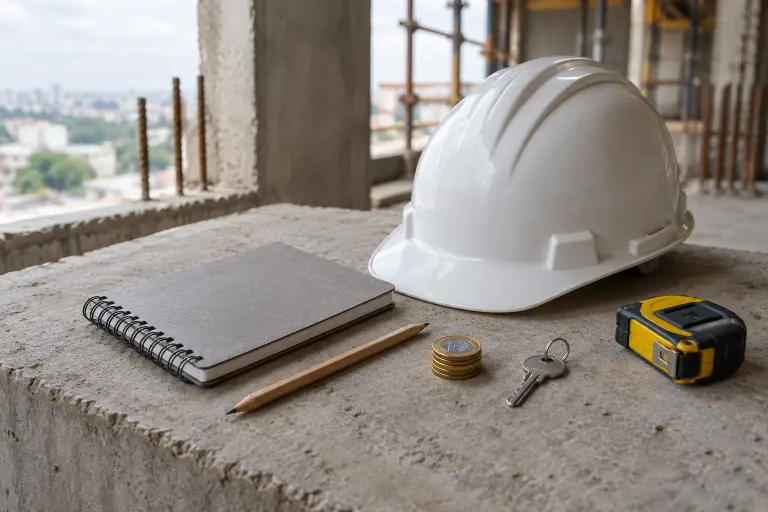
When you buy off-plan, you pay for years toward a building that does not exist yet. The question that weighs most in that math is simple: if the developer runs into trouble mid-construction, what happens to the money already paid?
In Brazil, the answer sits in six articles of the Real Estate Development Law, and this article ends with a checklist to verify everything in the property registry.
What patrimônio de afetação is
In practice, the regime creates a separate safe for each development. Land, construction and installment money go into that safe, with their own bank account and accounting, and they do not pay debts of another project or of the company.
It is a buyer protection that depends on the developer opting in and on a record at the property registry.
If you know off-plan markets where buyer deposits go into an escrow account, the idea is related but not the same: in Brazil buyers pay the developer directly, and what is ring-fenced is the whole project, assets and liabilities, not only your deposit.
The regime entered Law 4,591/1964 through Law 10,931/2004. Under article 31-A, the land, the improvements (everything built on it) and the other assets and rights of the development are set apart from the developer's estate, for a single purpose: finishing the construction and delivering the units.
Three rules in the same article show how the separation works:
- the ring-fenced assets answer only for the development's own debts and obligations (§ 1);
- its money only pays or reimburses expenses of that project (§ 6);
- land and construction can only secure loans whose full amount goes into building and delivering the units (§ 3, as worded by Law 14,620/2023).
Article 31-D completes the picture with the developer's duties, such as moving the funds through an account opened only for that project and keeping complete accounting records, even where tax law would not require it.
Opting in is voluntary. The text says a development may be ring-fenced "at the developer's discretion". Many companies opt in because the regime also gives access to the special tax regime of article 1 of Law 10,931/2004, which has changes planned under Brazil's tax reform (Complementary Law 214/2025).
What happens if the developer goes bankrupt
Article 31-F is the core of the protection. It says the developer's bankruptcy or civil insolvency does not reach the ring-fenced assets: the land, the construction, the receivables from buyers and the obligations of that project stay outside the bankrupt estate.
Without the regime, those assets go into the bankruptcy with the rest of the company. Buyers then compete for whatever is left with banks, suppliers and the tax authorities.
The buyers' meeting
Within 60 days of the bankruptcy ruling, buyers hold a general meeting. It can be called by the buyers' representative committee, by one sixth of the holders of ideal fractions, by the judge or, if the construction was financed, by the lending bank.
The meeting confirms or elects the committee and chooses between continuing the construction or liquidating the ring-fenced assets. To set up the construction condominium, the law requires two thirds of the votes on first call or an absolute majority on second call. The same rule applies to a stalled construction in the cases of article 43, item VI.
Continuing the construction has a cost
If the decision is to continue, buyers take over the development's rights and obligations, including the construction loan, if any (§ 11). Outstanding installments are then paid to the representative committee, not to the developer.
The point few people read is in § 12: if the money still to be received does not cover the cost of finishing the building, each buyer answers for the difference in proportion to their unit. The regime protects what was paid and what was built. It does not guarantee a finished building at the original price.
Simulation with round, hypothetical numbers, only to show the § 12 math. A building with 40 identical units needs R$ 8 million to be finished. The installments buyers still owe add up to R$ 6 million. The R$ 2 million gap, divided by each unit's coefficient, comes to R$ 50,000 per buyer, on top of the installments they already owed.
The representative committee also auctions, within 60 days of the meeting, the units the developer had not sold (§ 14). The auction money goes into the construction and reduces that gap. If money is left over at the end, the balance goes to the bankrupt estate (§ 13).
The representative committee and oversight
The law does not wait for a crisis to give buyers a voice. Article 50 provides for a buyers' representative committee (comissão de representantes) of at least three buyers, named in the contract or elected at a meeting called by the developer within six months of registering the development filing.
Under the regime, the developer owes the committee regular reporting (article 31-D):
- a construction status report at least every three months, comparing progress with the timeline and the funds received, signed by licensed professionals;
- quarterly trial balances for each ring-fenced project;
- free access to the site, the books, the contracts and the dedicated account for anyone appointed as inspector.
That inspector can be hired by the committee or by the lending bank, at their own expense (article 31-C). Whoever appoints the inspector takes on no responsibility for the quality or timeline of the construction, which remain with the developer and the builder.
The protection works better when buyers use these tools. A committee that never asks for the quarterly report finds the problem late.
If you are buying a unit with construction under way, ask the developer three questions: has the representative committee been elected, who are its members and when was the last quarterly report delivered. A vague answer to any of them is information in itself.
How to check the regime before signing
The regime only exists once recorded at the property registry (Registro de Imóveis). Under article 31-B, it is created by recording a declaration signed by the developer and, where applicable, by holders of rights over the land. Brochures and ads do not replace the record.
A five-step checklist:
- In the contract summary sheet (quadro-resumo), find the registration number of the development filing, the registry entry number (matrícula) and the registry office. The law requires the contract to include these details (article 35-A, item XI).
- Request an updated certificate of the registry entry from the registry office, at the counter or online through RI Digital, the national electronic property registry portal. The registry provides certificates of the development documents to anyone who asks (article 32, § 4).
- Look in the certificate for the registration of the development and the recorded ring-fencing declaration. When the regime is applied per building or per group of houses, each ring-fenced project appears separately (article 31-A, § 9).
- Check the encumbrances on the registry entry, such as a mortgage or fiduciary lien linked to the construction loan. The summary sheet must disclose them too (article 35-A, item X).
- Read the cancellation clause, because in a ring-fenced project the penalty can be higher.
These documents are in Portuguese. If you are buying from abroad, ask your broker or a Brazilian lawyer to walk you through the certificate, and keep a translated copy with your records.
Why check more carefully on the northern Santa Catarina coast
The region is in a cycle of many simultaneous launches. According to DWV platform data published by Exame on January 28, 2026, Porto Belo launched 18,899 units in 2025 and Itapema 12,623.
Many simultaneous projects mean many developers raising money from buyers at the same time. The regime is what stops one building's cash from being used to cover delays at another building by the same company.
The development registration is a different document with a different role, explained in our article on off-plan project registration in Brazil. The regime is one criterion among others, alongside delivery track record and construction pace, in the guide to choosing an off-plan development (in Portuguese).
What the regime does not protect
The regime reduces one specific risk: your project's money being mixed with the company's debts. The other risks of buying off-plan remain in the contract.
- Construction delays. The deadline and the grace period are in the summary sheet; the regime changes neither.
- Balance adjustment. Installments keep being adjusted by the contract index, usually the INCC (Brazil's construction cost index) during construction.
- Extra cost in a bankruptcy. Buyers may have to cover the gap to finish the building.
- Market. Resale price, rent and liquidity depend on supply and demand at the time of delivery.
- Financing at handover. If you plan to finance the balance, the bank assesses you close to delivery, and non-resident foreigners may find fewer options.
There is also an effect that weighs against buyers who walk away. Under Law 13,786/2018, when a buyer cancels the purchase of a ring-fenced unit, the penalty can reach 50% of the amount paid, against up to 25% in other cases (article 67-A, § 5).
The refund timing also changes: it is paid up to 30 days after the occupancy certificate (habite-se). The logic is to preserve the construction funds for those who stay.
The protection ends when the building is finished and registered. Since Law 14,382/2022, registering each contract, with the release from the lending bank, ends the regime for that unit without a separate record (article 31-E, § 1). That answers the question of how the regime is cancelled.
The regime as a selection criterion
Back to the opening question: in a bankruptcy, the segregated-assets regime keeps land, construction and installments outside the bankrupt estate and puts buyers in charge of the decision. It does not refund money automatically or finish the building on its own.
Three principles sum up how to use the rule:
- The regime is proven on the registry entry, with the recorded declaration.
- It protects the project's money, not the timeline, the resale price or the return.
- It works best with an active representative committee.
The practical step for tomorrow is to ask the developer for the registry entry and development filing numbers and request the certificate from the registry office before signing any offer.
If you want to read that certificate with a specialist, together with the development's price table and contract, book an online consultation or, if you are in the region, schedule a visit to the show unit and the site.
When buying off-plan in Brazil, safety starts at the registry office.
This article is for information only and does not replace advice from a lawyer licensed in Brazil.
Run the numbersOff-plan property or fixed income: compare the same moneyCDI: 13.65% a year (Central Bank of Brazil, 01/10/2026)Open the calculator